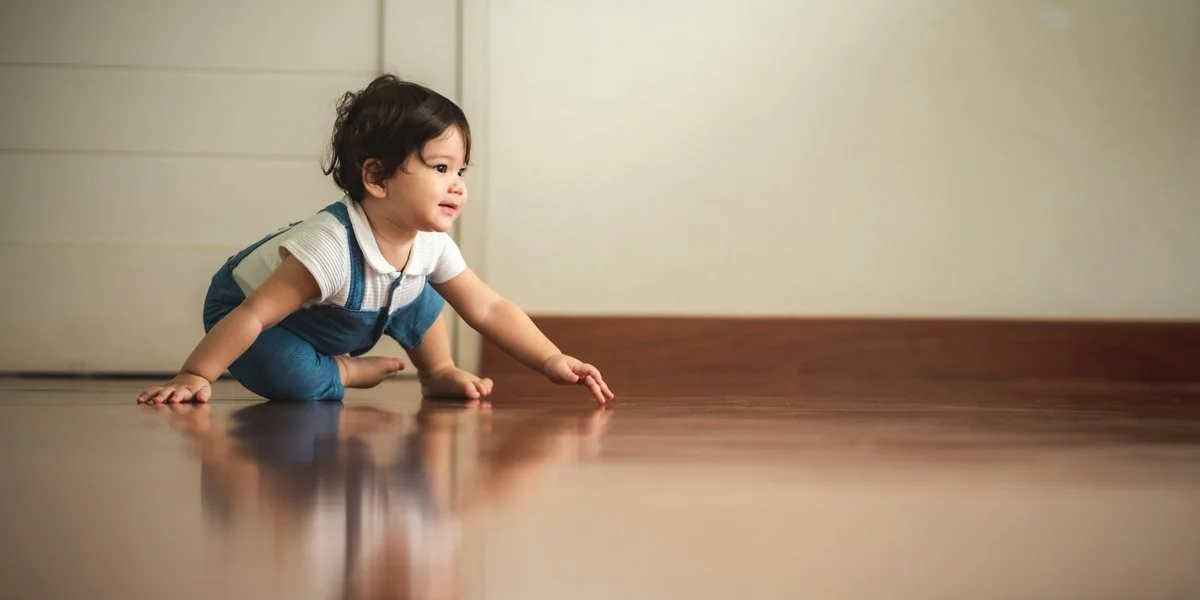
Crawling is one of the most important stages in early development, yet it’s also one of the most misunderstood.
Some babies crawl early, some later, and some move in ways that don’t look like “traditional” crawling at all. For parents, this can raise a lot of questions. What’s normal? What matters? And when should you pay closer attention?
Understanding crawling milestones can help you better support your child’s development and recognize patterns that may benefit from extra guidance.
When Do Babies Start Crawling?
Most babies begin crawling between 6 and 10 months, though there is a wide range of normal.
Before crawling begins, babies typically move through earlier stages like:
Tummy time
Rolling
Sitting independently
Pivoting or scooting
These early movements build the strength and coordination needed for crawling.
If you want to see how these early stages connect, you can explore newborn development from 0 to 3 months and infant milestones from 3 to 12 months.
What Does “Normal” Crawling Look Like?
The most recognized form of crawling is the classic hands-and-knees pattern, where babies move forward using opposite arm and leg movements.
However, not all babies crawl this way.
Common Crawling Variations
Some babies may:
Army crawl (pulling themselves forward on their stomach)
Scoot on their bottom
Crawl with one leg tucked under
Move backward before moving forward
Early on, these variations can still fall within a normal range of what’s considered “acceptable”. If you aren’t certain, you can seek out a professional opinion.
Why Crawling Is So Important
Crawling is more than just a way to get from one place to another. It plays a key role in how the brain and body develop together.
Crawling helps support:
Left-to-right coordination
Core strength and stability
Shoulder and hip development
Spatial awareness
Early motor planning
One of the most important aspects of crawling is how it supports communication between the left and right sides of the brain. As babies move opposite arm and leg together, they are strengthening the connection between both hemispheres. This coordination helps build the foundation for more complex skills like balance, standing, walking, learning, fine motor tasks, and even communication.
As babies continue progressing, crawling naturally transitions into pulling to stand and eventually walking. You can learn more about that transition in when babies start walking and what to expect.
What Is Crawling Asymmetry?
Crawling asymmetry happens when a baby consistently favours one side of the body over the other while moving.
This might look like:
Using one leg more than the other
Dragging one side of the body
Reaching primarily with one hand
Rotating or twisting in one direction
Crawling on hands and feet (bear crawl)
Scooting around on butt instead of getting on hands and knees
Occasional variation is normal, but consistent patterns are worth paying attention to.
Signs of Crawling Asymmetry to Watch For
Every baby develops differently, but some patterns may indicate that additional support could be helpful.
You may want to take a closer look if your baby:
Consistently uses one side more than the other
Avoids putting weight through one arm or leg
Has difficulty coordinating opposite arm and leg movements
Appears unstable or collapses frequently while crawling
Shows a strong preference for turning or moving in one direction
These patterns don’t necessarily mean something is wrong, but they can be early indicators of imbalance in movement or coordination.
What If My Baby Doesn’t Crawl?
Some babies skip crawling entirely and move straight into standing and walking.
While this can happen, crawling provides important developmental benefits that are hard to fully replicate through other movements. It helps build coordination between both sides of the body, which is important for many future skills.
If your baby is not crawling, it can be helpful to look at how they are moving overall:
Are they exploring their environment?
Are they building strength and coordination in other ways?
Are they progressing through other milestones?
Looking at the full picture matters more than any single milestone.
For a broader understanding of how milestones build over time, you can refer to our complete guide to baby development milestones.
How Crawling Connects to Later Development
Crawling plays a key role in preparing the body for the next stages of movement.
As babies crawl, they are:
Strengthening the muscles needed for standing
Learning how to shift weight and balance
Developing coordination that carries into walking
These patterns continue into toddlerhood, where movement becomes more refined and independent. You can explore how this evolves further in toddler developmental milestones.
Supporting Healthy Crawling Development
There are simple ways to support your baby during this stage:
Prioritize tummy time early and often
Give your baby space to move freely on the floor
Limit time in devices that restrict movement
Encourage reaching, turning, and exploring
Place toys slightly out of reach to promote movement
The goal is not to force crawling, but to create an environment where it can develop naturally.
A Key Stage That Builds Everything Forward
Crawling may seem like just another milestone, but it plays a much bigger role in development than many people realize.
It helps build the foundation for movement, coordination, and balance, all of which carry forward into walking, play, and everyday activities.
Every baby will approach this stage differently, but understanding what to look for can help you feel more confident in supporting their development.
Supporting Your Child’s Development at Every Stage
From early movement patterns to more advanced coordination, each stage of development builds on the last.
If you have questions about your child’s movement, crawling patterns, or overall development, our team at Cameron Family Chiropractic in Calgary is here to help guide you.
Contact us today to learn more about how we support healthy development for growing families.